Queensland’s protected areas are some of the state’s greatest environmental assets. But their long-term health depends on far more than what happens within park boundaries.
Wildfire, invasive weeds and feral animals, declining habitat connectivity, degraded waterways and changing land use don’t stop at fence lines. Managing these pressures requires a landscape-scale approach that brings together public land managers, private landholders, Traditional Owners, local government and communities to protect the ecosystems that connect Queensland’s natural landscapes.
That’s exactly what the Queensland Government’s Natural Resource Management Expansion Program (NRMEP) is delivering.
Backed by a $117.84 million investment, the program is supporting 30+ projects across Queensland that improve land, water and biodiversity outcomes through practical, on-ground action. Delivered by Queensland’s regional NRM organisations, the program complements the work of Queensland Government agencies – including the Queensland Parks and Wildlife Service – by addressing many of the threats that originate beyond the boundaries of protected areas.
Delivering NRM outcomes where they matter most
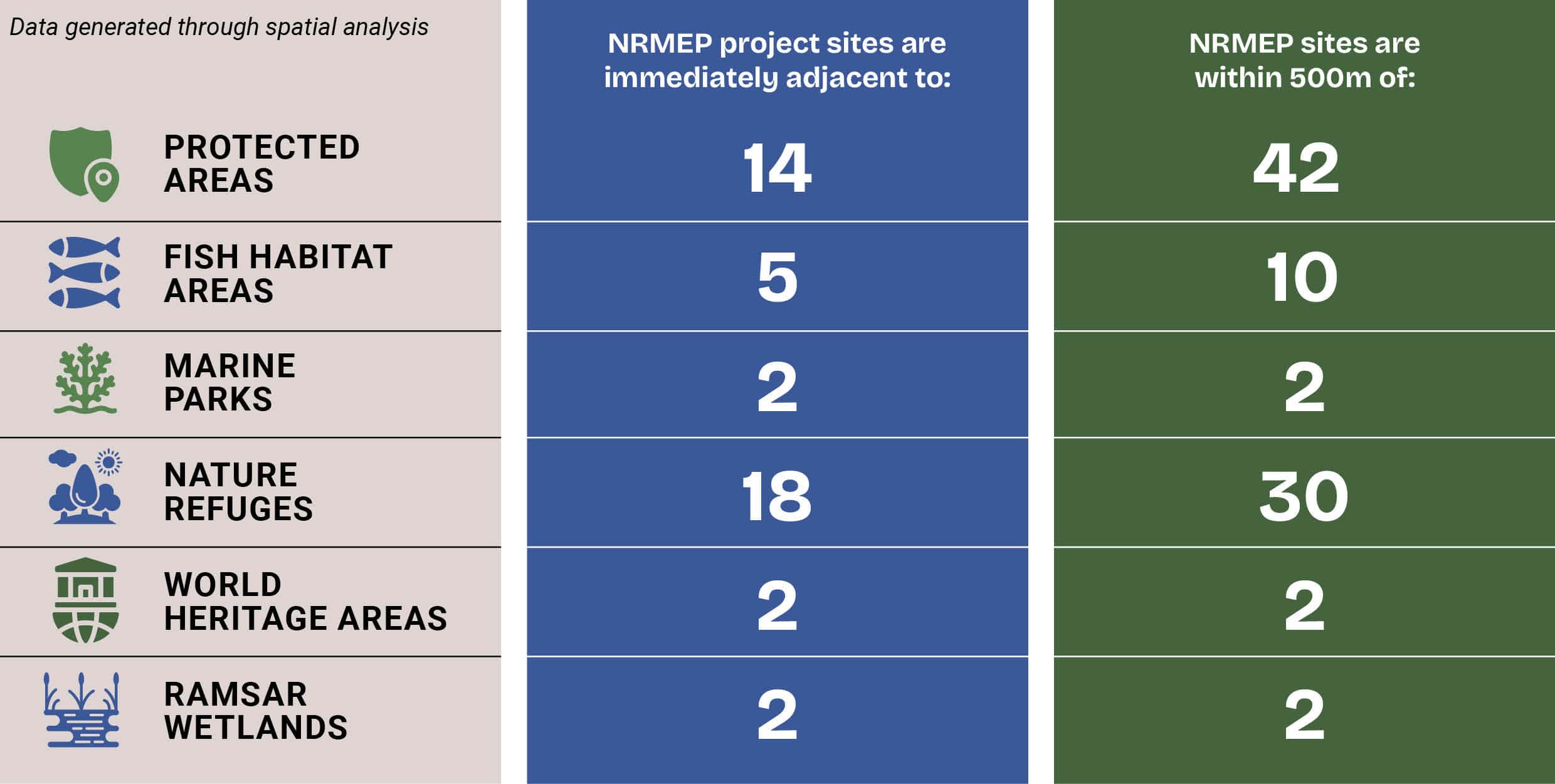
Spatial analysis demonstrates the close relationship between NRMEP projects and Queensland’s most significant conservation assets. The following infographic provides a snapshot of the proximity of NRMEP projects
Current project sites are located immediately adjacent to:
- 14 Protected Areas
- 5 Fish Habitat Areas
- 2 Marine Parks
- 18 Nature Refuges
- 2 Ramsar Wetlands
A further:
- 42 Protected Areas
- 10 Fish Habitat Areas
- 2 Marine Parks
- 30 Nature Refuges
- 2 World Heritage Areas
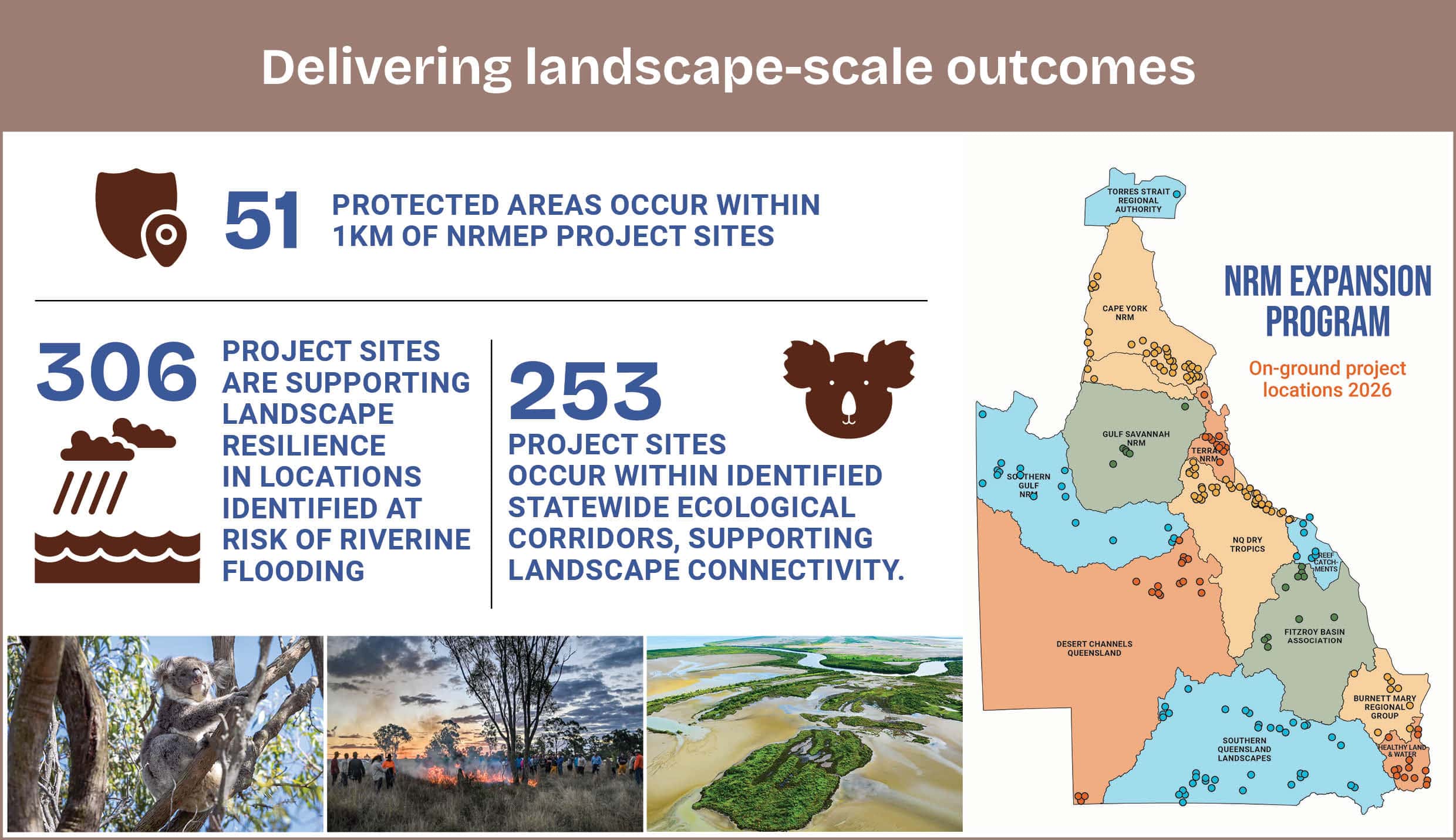
are located within 500 metres of NRMEP project sites. In total, 51 Protected Areas occur within one kilometre of NRMEP projects, highlighting the strong alignment between regional NRM investment and Queensland’s protected area estate.
The program is also strengthening ecological connectivity across the broader landscape, with 253 project locations situated within identified statewide ecological corridors and 306 project locations helping build flood resilience.
Strengthening Queensland’s protected area network
The figures tell an important story.
Queensland’s protected areas cannot be managed in isolation and many of the threats affecting these areas begin outside their boundaries. By improving the health and resilience of surrounding landscapes, the NRM Expansion Program is helping protect the ecological values that parks depend upon.
Nature Refuges provide an excellent example of this landscape-scale approach. The program is delivering on-ground work within or immediately adjacent to 18 Nature Refuges, involving 46 project areas, while a further 30 Nature Refuges lie within 500 metres of 56 project areas. Together, these projects are strengthening Queensland’s growing network of private protected areas by improving habitat condition, ecological connectivity and resilience across surrounding landscapes.
Projects making a difference
Across Queensland and in partnership with their communities, regional NRM organisations are delivering practical projects that demonstrate the value of cross-tenure conservation.
Building wildfire resilience across Cape York
The Cape York Wildfire Resilience project is reducing the risk of destructive late dry season wildfires across one of Australia’s most fire-prone landscapes. Working with Traditional Owners, graziers and land managers, the project is improving wildfire resilience across 40,000 hectares of native vegetation through coordinated early dry season burning and fire planning.
With more than 60 per cent of Cape York Peninsula held as Aboriginal Freehold land, Indigenous-led fire management is central to the project, protecting high-value native vegetation, threatened species habitat and surrounding landscapes through more appropriate fire regimes.
Tackling invasive species across connected landscapes
The Fighting Invasive Species Together project demonstrates how coordinated action across land tenures can reduce shared threats before they impact protected areas.
Working alongside four Indigenous Land and Sea Ranger groups, Queensland Parks and Wildlife Service, local government and landholders, the project is delivering coordinated weed and feral animal control, cultural burning and monitoring across Magnetic Island, Palm Island and the Lower Burdekin. Over three years, it will improve 26 hectares of native vegetation, increase wildfire resilience across 2,000 hectares, undertake 36 invasive species control activities and deliver six cultural burns to restore healthier, more resilient landscapes.
Restoring nationally significant Brigalow Country
The Nature Positive Fitzroy Farms project is showing how biodiversity conservation and productive agriculture can work together.
Working with land managers across 17,680 hectares, the project is improving vegetation condition, restoring soil health and protecting habitat within the Brigalow bioregion—home to 21 nationally listed Threatened Ecological Communities and more than 200 threatened plant and animal species. By improving habitat across working landscapes, the project is helping reconnect fragmented ecosystems and strengthen biodiversity across one of Queensland’s most significant ecological regions.
Delivering connected conservation
Regional NRM organisations have spent decades building trusted partnerships with landholders, Traditional Owners, conservation and landcare organisations, industry and government agencies. Those partnerships enable coordinated action across public and private land – something that no single land manager can achieve alone.
The Natural Resource Management Expansion Program recognises that healthy protected areas rely on healthy surrounding landscapes. By investing beyond reserve boundaries, the Queensland Government is helping reduce landscape-scale threats, improve habitat connectivity and build more resilient ecosystems across Queensland.
It is a practical demonstration that protecting Queensland’s natural assets is not just about managing parks – it’s about working together to manage the landscapes that sustain them.
Feature image: Cultural Fire to manage invasive weeds and pests in the Burdekin Dry Tropics – photo Scott Radford-Chisholm, courtesy NQ Dry Tropics
The Queensland Government’s Natural Resource Management Expansion Program is delivered in collaboration with NRM Regions Queensland.