A recent state-wide webinar hosted by Queensland Water and Land Carers provided an opportunity for NRM Regions Queensland (NRMRQ) to share an update on Queensland’s Natural Resource Management Expansion Program (NRMEP) and highlight the important role Landcare groups are playing in delivering outcomes across the state.
Delivered as part of NRMRQ’s NRMEP Governance and Communications project, the webinar brought together representatives from Landcare groups, catchment groups and regional NRM organisations to explore the relationship between the two sectors and showcase examples of collaboration already occurring through the program.
The webinar highlighted that while regional NRM organisations and Landcare groups have distinct roles, they share many common goals. Regional NRM organisations provide regional planning, investment coordination and program management, while Landcare groups contribute local knowledge, community relationships, stewardship and practical on-ground delivery.
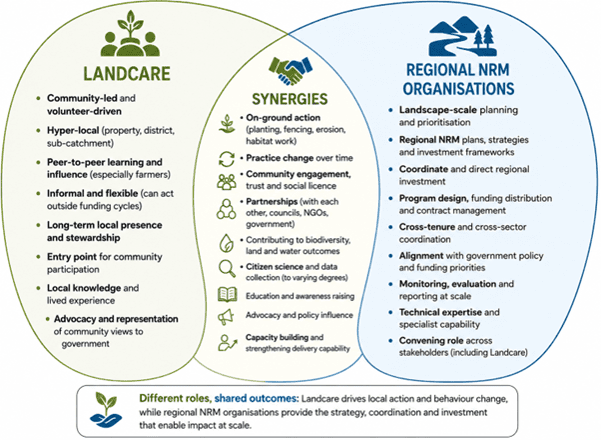
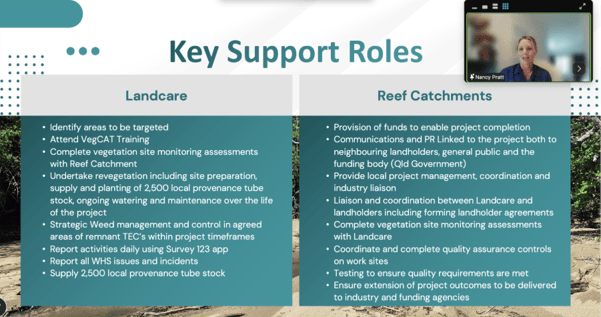
Participants heard that more than 25 per cent of currently approved on-ground NRMEP projects involve Landcare or catchment groups in some capacity, with at least 15 organisations already contributing to delivery across Queensland. These partnerships range from contracted on-ground works and habitat restoration through to native plant production, monitoring, citizen science, community engagement and stewardship activities. 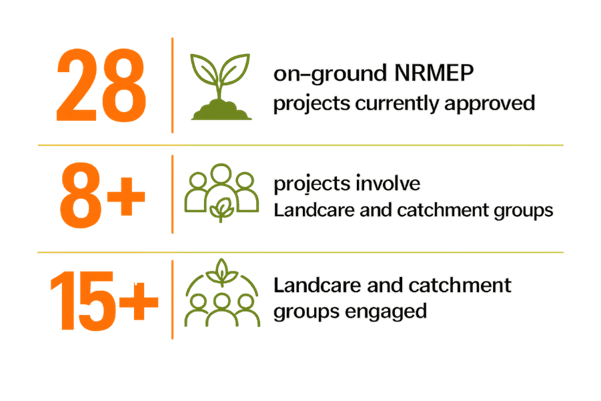 A highlight of the webinar was a case study presented by Nancy Pratt, Operations Manager of Pioneer Catchment and Landcare, who outlined how the Central Queensland Coast Landcare Network is partnering with Reef Catchments to deliver the Threatened Ecological Communities project. The project focuses on protecting and restoring two nationally listed threatened ecological communities – Beach Scrub (Littoral Rainforest and Coastal Vine Thickets of Eastern Australia) and Broad Leaf Tea-tree Woodlands – which have experienced significant declines due to historical clearing, development and other environmental pressures.
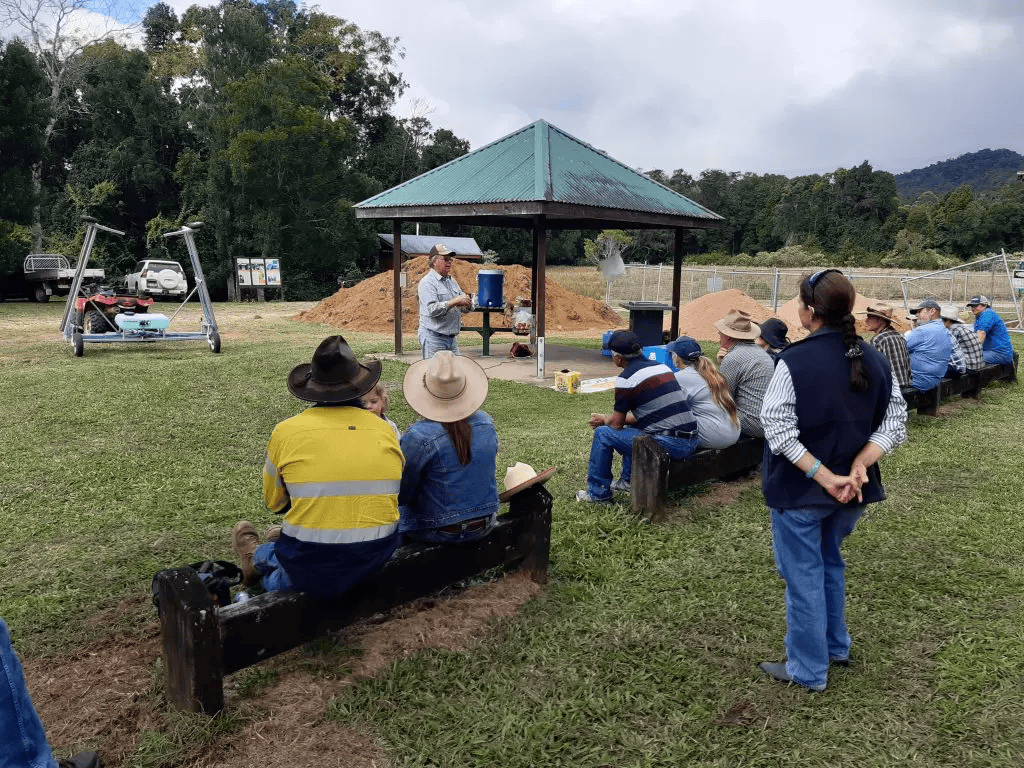
Photo: Pioneer Catchment and Landcare
Through the partnership, Whitsunday Catchment Landcare, Pioneer Catchment and Landcare, and Sarina Catchment Landcare Management Association are delivering practical restoration activities across 42 sites. Over the next three years, the Landcare groups will undertake 90 hectares of weed management and control, restore three hectares of degraded habitat through revegetation, protect remnant vegetation and assist with monitoring and assessment activities. Community engagement and landholder education will also form an important part of the project.
“As Landcare groups, we’re proud to be partnering with Reef Catchments on this important project,” Ms Pratt said. “The collaboration brings together the strengths of each of our organisations to deliver practical on-ground restoration activities.”
The webinar also highlighted the significant capability that exists within Queensland’s Landcare sector. Collectively, the three organisations involved in the project also make up the Central Queensland Coast Landcare Network employing 21 staff, working across more than 937,000 hectares and delivering services including revegetation, bushland maintenance, native plant propagation, ecological consultancy, landholder support, education and conservation initiatives.
For NRMRQ, the webinar demonstrated the value of creating opportunities for different parts of the natural resource management community to learn from one another, share experiences and build stronger partnerships.
By strengthening collaboration between regional NRM organisations, Landcare groups and other stakeholders, the Governance and Communications project is helping support the successful delivery of Queensland’s $117.84 million NRM Expansion Program and ensuring the benefits of the investment are shared across the broader NRM community.
This activity was delivered through NRM Regions Queensland’s Governance and Communications project, funded through the Queensland Government’s Natural Resource Management Expansion Program.