The State-wide Indicators Framework (SWIF) provides organisations delivering natural resource management projects in Queensland with consistent methods and tools for collecting project impact data.
The first of its kind in Australia, SWIF includes smart systems for analysing this data and combining it to tell a compelling and credible whole-of-Queensland story. It was developed by NRM Regions Queensland’s Lee Blacklock and consultant Penny Scott, in collaboration with the Queensland Government.
To ensure consistent, accurate data collection across the state, training is provided to organisations using the Framework. This is an opportunity to update users on recent developments and equip new staff with the skills to collect data using the system.
What are CATs?
The SWIF toolkit includes a range of methods for monitoring ecological condition—commonly referred to as Condition Assessment Tools (CATs). One of these is the Vegetation Condition Assessment Tool (VegCAT), a rapid ecological monitoring method that tracks changes in native vegetation condition.
The method involves establishing a monitoring plot and collecting data, including ground cover, vegetation regeneration, weeds, and the structure of trees/shrubs. Uploading this information to the VegCAT app generates a condition score.
Other methods in the SWIF toolkit include the Wetlands Condition Assessment Tool (WetCAT) and the Land Condition Assessment Tool (LCAT), both with companion data collection apps.
The data gathered through the apps is analysed and combined into a state-wide dataset that feeds an online SWIF dashboard.
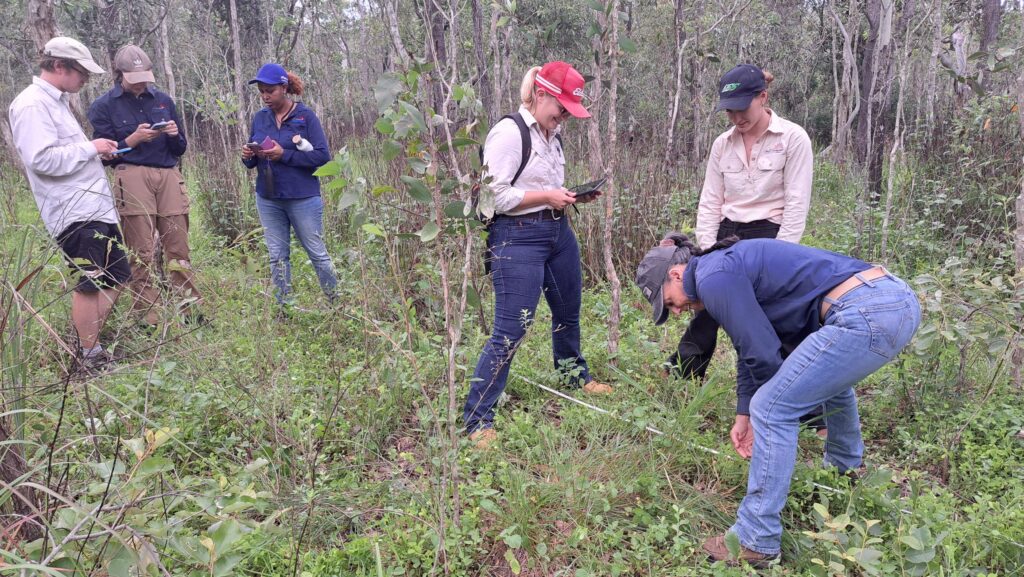
NRM practitioners using the VegCAT tool in field training.
Training receives positive feedback
The NRM Regions Queensland SWIF team, made up of Penny Scott and Lee Blacklock, regularly travels to regional Queensland to deliver face-to-face training on both SWIF and VegCAT.
Training always includes sessions on the use of GIS tools, as well as demonstrations of the latest reporting and visualisation products.
In 2024–25, the team delivered 12 regional training events to more than 150 participants from 12 Natural Resource Recovery Program delivery partners.
The training sessions were well received, with participants reporting high levels of satisfaction. Importantly, the evaluation showed a significant increase in knowledge of SWIF and VegCAT following the training.
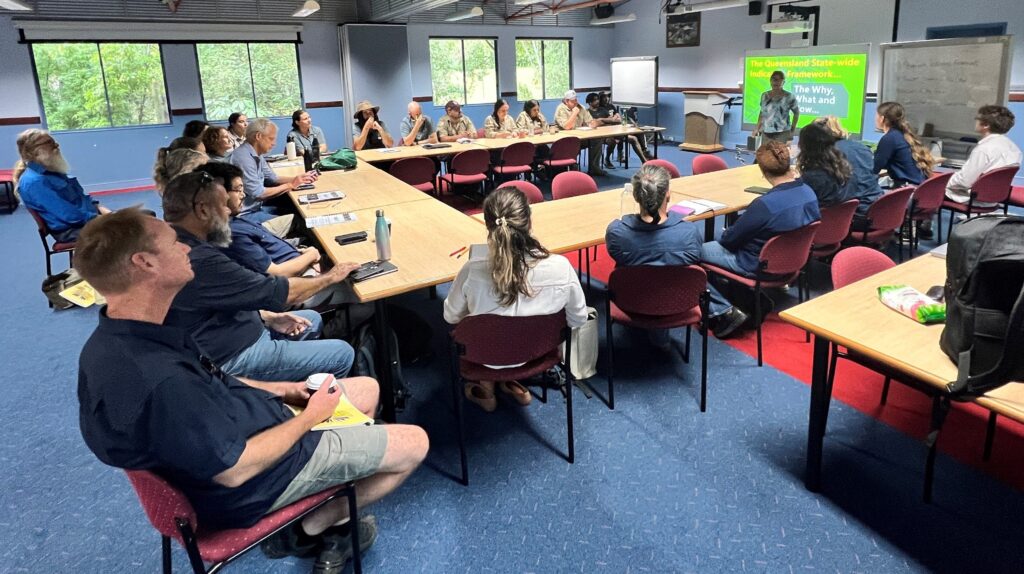
“It was a great session, very informative and the SWIF team are fantastic trainers, full of energy and wisdom.”
Value of cross-organisational training
Two of the training sessions were delivered to multiple organisations at the same time—and these were some of the most successful.
Participants benefited not only from building their knowledge, but also from connecting and networking with neighbouring organisations.
“In my experience, some of the best NRM outcomes have happened when we’ve brought different groups together to share ideas and knowledge. Every region is different, and when we take the time to listen to each other, we come up with better ideas and ways of doing things than we ever could alone.” Evizel Seymour, Terrain NRM
Face-to-face is best
Operating a consistent, state-wide data collection system has its challenges. At the top of the list is ensuring all organisations have the same understanding of the system and are collecting data in the same way.
Face-to-face training is extremely beneficial. To gain a true understanding of SWIF and methods such as VegCAT, participants need to get out into the field and use the tools. All training sessions had a mixture of classroom learning and fieldwork, providing a practical, hands-on experience.
However, there is always room for improvement. Evaluation feedback suggested training could make use of local projects to demonstrate in more detail how the system works, as well as providing more technical support to identify species in the field.
This project is funded by the Queensland Government’s Natural Resources Recovery Program.
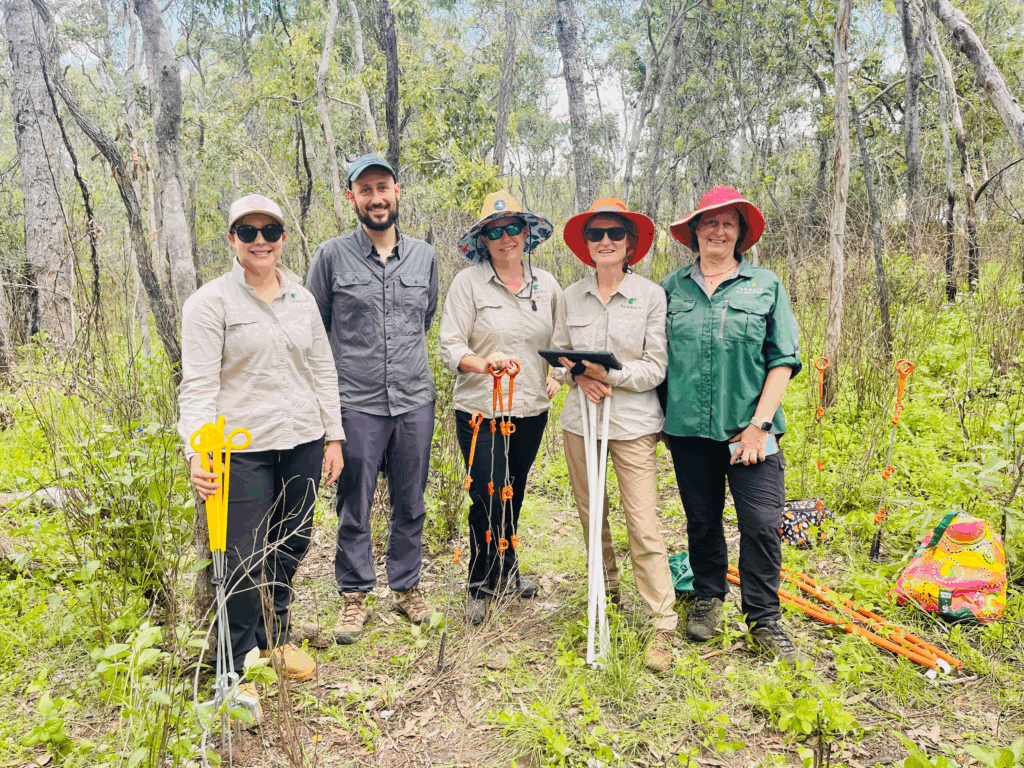
Terrain NRM staff taking part in SWIF and VegCAT training. Credit: Terrain NRM.